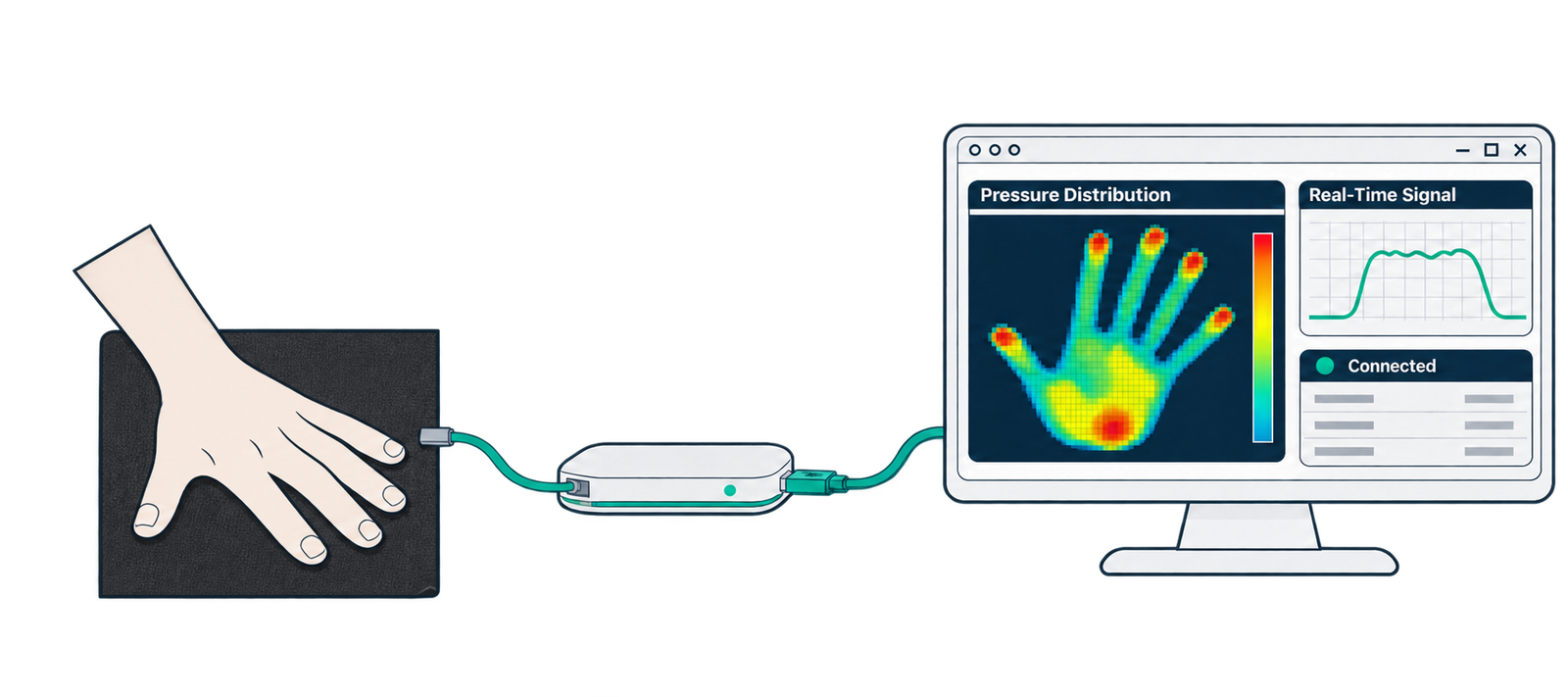
Schematic Diagram of Acquisition Module and Software Demonstration
Technical Advantages
General Sensor Parameters
Complex Curved Fit
Snug fit for irregular curved surfaces, seamless embedding in wearables & textiles
Sharp Fold Resistant
Stable sensing after tens of thousands of sharp folds, no circuit failure
Ultra-Thin Structure
Minimum thickness 0.1mm, flush built into fabrics with no bulge
Superior Environmental Adaptability
Reliable operation from -40℃ to 90℃, humidity within 95%
Comprehensive Dynamic and Static Pressure Testing
Can detect both dynamic impact force and static steady pressure, while piezoelectric & triboelectric solutions fail static measurement.
High-Sensitivity Sensing Response
High sensing sensitivity, precisely identifies tiny pressure fluctuations for complete fine data.
Product Performance Comparison
Characteristics of Pressure Distribution Test Systems Based on Different Operating Principles
Capacitive
Dynamic force: Can be measured
Static force: Can be measured
Sensitivity: High
Immunity to interference: Susceptible to external interference
Flexibility: Moderate
Thickness: 0.3–0.5 mm
Service life: Decay in rolling accuracy in the ten-thousands range
Temperature and humidity: 0–60 °C, humidity < 80%
Sampling frequency: 5–50 Hz
Piezoresistive
Dynamic force: Can be measured Static force: Can be measured
Sensitivity: High
Immunity to interference: Not easily affected by external interference
Flexibility: High flexural resistance, enabling it to conform to complex curved surfaces
Thickness: As thin as 0.1 mm
Service life: 100,000 cycles at 1,500 N with stable roll resistance
Temperature andhumidity: -40°C to 90°C, humidity ≤ 95%
Sampling frequency: 1–100 Hz, full-range coverage
Piezoelectric
Dynamic force: Can be measured
Static force: Difficult to measure
Sensitivity: High
Immunity to interference: Not easily affected by external interference
Flexibility: Average; frequent bending can cause wear
Thickness: 0.2–0.4 mm
Service life: Prone to fatigue and aging under high-frequency compression
Temperature and humidity: -20–70°C; performance declines in high humidity
Sampling frequency: Compatible only with high frequencies of 20–200 Hz
Triboelectric
Dynamic force: Can be measured
Static force: Difficult to measure
Sensitivity: Average
Immunity to interference: Susceptible to external interference
Flexibility: Acceptable; signal fluctuates significantly when bent
Thickness: 0.25–0.5 mm
Service life: High friction wear; short overall service life
Temperature and humidity: Output is significantly affected by temperature and humidity fluctuations
Sampling frequency: Usable only under high-speed dynamic conditions
Scenario-Based Solutions
Embodied Intelligence Series
Capturing high-fidelity tactile and motion data for robots and embodied AI systems, enabling large-scale training datasets and stronger model generalization and dexterous manipulation.
An expandable technology ecosystem that continuously drives product upgrades
The technical principle builds an open, iterative and scalable underlying technical ecosystem, supporting continuous algorithm optimization and functional expansion.