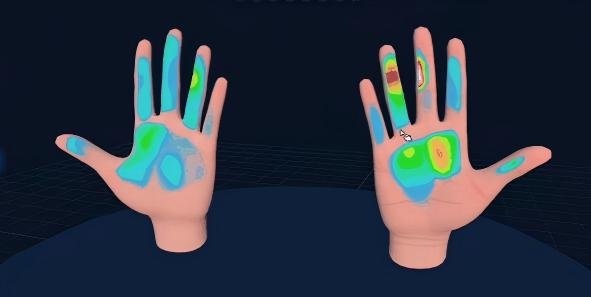
Built on a flexible pressure-sensing array, the system converts changes in contact loading between an occupant and the seat into continuous, intuitive pressure data. This provides a data foundation for seated-posture sensing, occupant-state analysis, and seat-comfort optimization.

As smart cockpits move beyond voice interaction and visual recognition toward more comprehensive vehicle-occupant sensing, an often overlooked foundational capability is becoming increasingly important: sensing contact between occupants and their seats.
The seat is an important interface for continuous contact between the human body and the vehicle. Sitting down, adjusting posture, or shifting the center of gravity produces different pressure distributions across the backrest and seat cushion.
Using flexible pressure-sensing technology, the Zhonghongxin Smart Pressure-Sensing Seat Cushion converts these less visible changes in contact loading into visual data, enabling the seat to move from “passive support” to “active sensing.”
01 Flexible pressure-sensing array

The product uses fiber based flexible pressure sensors composed of a comfort layer, a sensing layer, and a protective layer. While collecting pressure data, this structure also addresses comfort at the point of body contact and protection of the sensors.
A flexible pressure-sensing layer comprising multiple sensing units is integrated into the smart seat cushion. When an occupant sits down, the lower back, hips, and legs exert different contact pressures. The sensing units convert local changes in loading into electrical signals that can be acquired, while multiple nodes together form a two-dimensional pressure distribution. Unlike single-point pressure measurements, array sensing can indicate not only whether pressure is present, but also where it occurs, the area it covers, and how it changes. The flexible structure conforms more readily to the shape of the seat surface, providing a basis for sensing multiple points across the backrest, seat cushion, and other contact areas.
From the seat surface, through the flexible sensing array, to the cushioning and support structure, pressure information is collected without changing the basic way the seat is used.
02 From pressure signals to visual data
A complete cockpit pressure-sensing process consists of four main stages:
Multi-point sensing. The flexible array captures changes in contact loading across different regions of the seat.
Signal acquisition. The acquisition module reads and preprocesses signals from multiple sensing nodes.
Pressure mapping. The system converts the distributed sensing signals into pressure heatmaps or pressure distribution data.
Application output. The pressure data can then be made available to cockpit algorithms, seat development, or interaction systems.
Different colors in the heatmap represent the relative pressure distribution, making loading conditions that are normally hidden within the seat easier to see.
03 Dynamic responses that track changes in posture
Occupants do not remain in the same seated posture throughout a journey.
Leaning forward, leaning back, moving sideways, and shifting the center of gravity all change the contact areas between the body and the seat. By continuously collecting pressure information, the smart seat cushion updates the pressure display in step with changes in body position.
These dynamic data help developers observe differences in loading before and after a change in posture, and provide a more continuous data basis for analyzing conditions inside the cockpit.

As the occupant’s posture changes, the pressure distribution across different regions of the seat changes accordingly.
04 Technical features of the smart seat cushion
Distributed sensing across multiple regions. Pressure is collected at multiple points in contact areas such as the backrest, hips, and legs.
Pressure distribution visible in real time. Heatmaps show the locations of contact loading and changes in relative pressure.
Flexible conformity and structural adaptability. The flexible sensing layer can readily adapt to different seat surfaces and application structures.
Continuous feedback on dynamic conditions. The system records the process of sitting down, adjusting posture, and shifting the center of gravity.
Extensible data interfaces. An extensible data input is provided for seat development, cockpit algorithms, and human-machine interaction.
05 From sensing technology to cockpit applications
Driver posture sensing. Changes in contact loading across different regions of the driver’s seat are collected to provide reference data for posture analysis and cockpit interaction strategies.
Occupant-state monitoring. Sensing seat occupancy and changes in pressure distribution provides basic data for functions related to the occupant’s state.
Seat-comfort optimization. Analysis of pressure concentration and dispersion across different regions supports the evaluation of seat structures, materials, and support solutions.
Coordinated interaction within smart cockpits. Pressure-sensing input is provided for personalized seat adjustment and other human-machine interaction functions.